What to Expect After an Amputation: The First 90 Days
What to Expect After an Amputation: The First 90 Days
An emotional and practical guide for new amputees, those preparing for surgery, and the people who love them.
If you are reading this before surgery, you might be trying to be brave while your mind races ahead. If you are reading this after surgery, you might feel like everything happened so fast that your emotions have not caught up yet. Either way, please hear this clearly:
You are not behind. You are not failing. You are in the very beginning of a real recovery, and there is a path forward.
As board-certified prosthetists, we have walked alongside people after amputation for decades. Some arrive feeling determined. Some arrive numb. Some arrive grieving deeply. Most arrive with a mix of hope and fear, sometimes in the same sentence. All of those reactions are human, and all of them deserve gentleness.
This article is for people with upper-limb or lower-limb amputations, and for families who are trying to help without knowing what to say. The first 90 days are not about “having it all figured out.” They are about healing, learning, and building a plan that supports the life you want to create going forward.

The first thing to know: recovery is more than physical
Amputation changes your body, but it also changes your sense of safety, identity, and independence. It can bring grief, relief, anger, gratitude, guilt, fear, or none of the above at first. Many people ask, “Is this normal?” The answer is usually yes.
A helpful way to think about the first 90 days is this: you are recovering from surgery, adjusting to a new reality, and building new skills at the same time. That is a lot. It is also possible.
Your care team, and where a prosthetist fits in
People often assume prosthetics starts when you are “ready to walk” or “ready to use an arm again.” In reality, good prosthetic care starts earlier than most people realize, and it begins with listening and planning.
Here is the care team you will commonly experience, and what each part does:
Surgeon and medical team: monitors healing, manages medical needs, clears you for the next steps.
Wound care: supports incision care, skin health, and tissue healing.
Physical therapy (PT) and occupational therapy (OT): teaches safe movement, strength, balance, and everyday skills. For upper limb, OT is often central for function and adaptation.
Prosthetist: helps plan for a prosthesis, protects your healing, guides limb shaping when appropriate, and later designs and fine-tunes a custom device.

Your timeline will depend on your health, your healing, and why the amputation happened. Recovery after trauma may look different than recovery after cancer, infection, or vascular disease. People with diabetes or peripheral arterial disease (PAD) sometimes need closer skin monitoring and a slower, steadier pace. Pediatric cases bring their own unique needs and emotions, especially for parents who are trying to protect their child and also encourage confidence.
Different stories, same truth: you deserve a plan that fits you.
Days 1–7: stabilization, pain management, and “what just happened?”
In the first week, your job is not to be brave. Your job is to heal and stay safe.
You might experience pain at the surgical site, general soreness, and fatigue. You may also feel phantom sensations. Many people describe feeling like the limb is still there, or they experience tingling, pressure, or discomfort that seems to come from the missing limb. This can be unsettling, but it is a common experience. Always tell your medical team what you feel so they can support you appropriately.
From the prosthetic side, we are usually thinking about three things early on:
Protecting your healing tissue
Supporting good positioning and movement habits (in partnership with PT/OT)
Learning your goals and your daily life, so we can plan wisely later
Even if you are nowhere near getting a prosthesis yet, a prosthetic conversation can be reassuring because it turns “I don’t know” into “Here’s the next step.”

Weeks 2–4: healing, swelling changes, and finding a rhythm
As the incision heals, swelling often changes rapidly. This is true for upper- and lower-limb amputations. Some days the limb looks smaller, other days it feels fuller or more sensitive. This is normal early on, and it is one reason prosthetic fitting is a process, not a single appointment.
This phase can be emotionally hard because you may feel well enough to want progress, but your body is still doing deep repair work. For people who had an amputation related to diabetes, PAD, or infection, your team may be extra cautious to protect skin integrity and circulation. For people recovering from trauma, the emotional system can stay on high alert, even after the physical danger has passed. For people recovering after cancer, there may be layers of fatigue and follow-up care that affect pacing.
What you can focus on now is consistency:
show up to therapy when you can
practice the basics your therapist gives you
keep communication open with your care team
allow rest to be part of the plan, not a setback

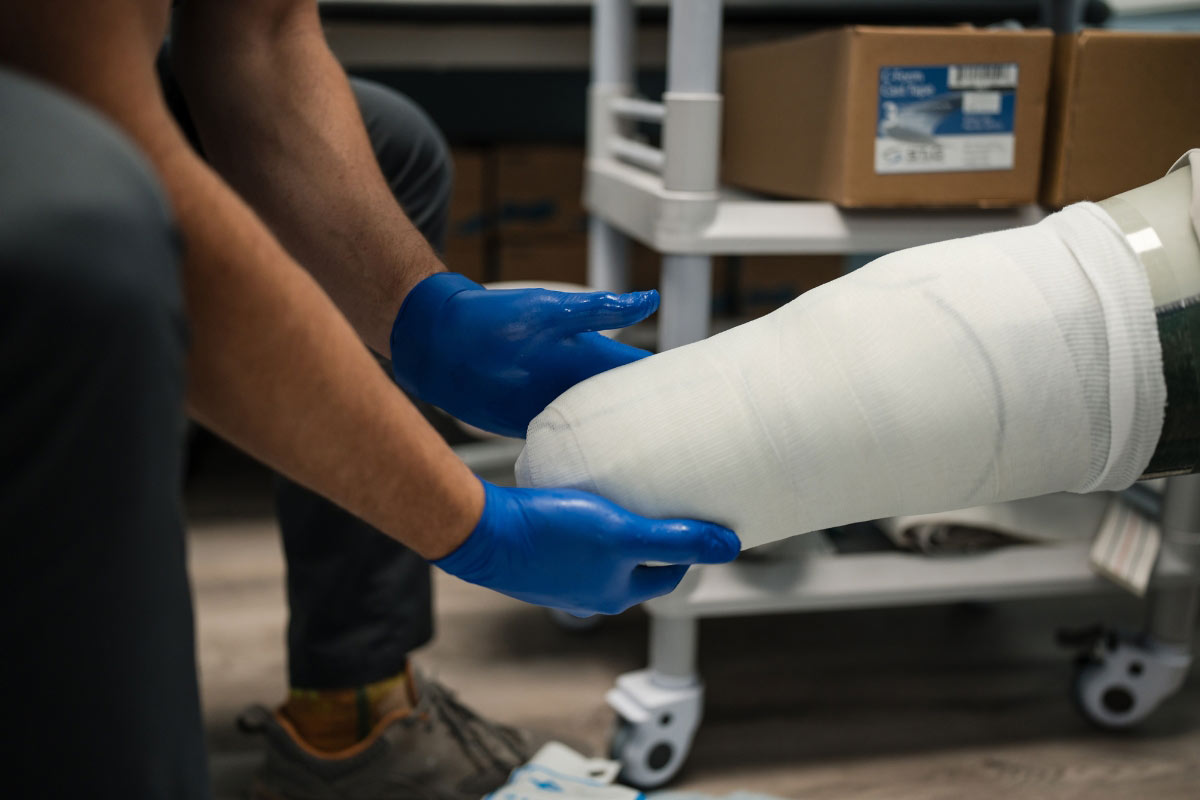
If you meet with a prosthetist during this time, we may talk about limb shaping tools (like shrinkers or other compression options) when medically appropriate. We may also teach you what to watch for with skin changes, sensitivity, and limb volume. For many people, simply having a roadmap reduces anxiety.
Weeks 4–8: planning the prosthesis, not rushing the prosthesis
A lot of people ask, “When do I get my prosthesis?” It is a reasonable question, but it is not always the most helpful one.
A better question is: “What needs to be true before prosthetic fitting goes smoothly?”
In most cases, we want:
stable healing, with medical clearance
manageable swelling (not perfect, just trending in a good direction)
skin that can tolerate gentle pressure
enough strength and balance to train safely, if it’s lower limb
enough comfort and range of motion to begin functional training, if it’s upper limb
During this phase, you might start exploring what a long-term, custom prosthesis could look like. That could mean learning the difference between early devices and more definitive ones, talking through realistic goals, and understanding what affects function.

For lower limb, that conversation often includes safety, energy use, and mobility goals like returning to work, walking in the community, or getting back to hobbies. For upper limb, the conversation often includes comfort, control options, task-specific needs, and what you want your hand, hook, or terminal device to do in real life.
As your prosthetist, our role is to translate your life into a prosthetic plan. Not a brochure. Not a generic answer. Your plan.
Weeks 6–10: the fitting process and the learning curve
When prosthetic fitting begins, it helps to know this upfront: the first prosthesis, and the first fittings, can feel emotional. Some people cry because it feels like hope. Some people cry because it feels unfamiliar. Some people feel disappointed because it is not immediately “easy.”
All of those reactions are normal.
Prosthetic fitting usually includes careful measurements or scanning, a first socket or interface that is tested and adjusted, and then a period of learning and refinement. Fit matters because it affects comfort, skin health, and control. Alignment and positioning matter because they affect stability, posture, and how much effort the body needs to move.
It is also normal for adjustments to be frequent in the beginning. Your body is changing, and your skills are changing. Prosthetics should respond to both.
If you are a parent supporting a child, this phase can include big feelings for the whole family. Kids often adapt with surprising courage, but they also need space to feel sad or frustrated. Parents need support too, and you deserve a team that speaks to you with patience and clarity.
Weeks 10–13: confidence returns in small, real ways
By this point, many people begin to notice victories that do not look dramatic, but feel life-changing.
It might be:
standing at the sink without thinking about it
carrying a cup from the kitchen to the couch
getting dressed without needing help
walking to the mailbox
returning to a familiar routine
laughing again and realizing it did not hurt to laugh
Prosthetically, this phase is often about fine-tuning. A socket may need modifications. Components may need adjustment. Your wear schedule may expand gradually. Your therapy goals may become more specific, like stairs, uneven ground, workplace tasks, or endurance.

This is also where many people begin thinking more seriously about a long-term, custom prosthesis that matches their lifestyle. That conversation should be honest and practical, and it should still hold hope.
A short safety section: when to call your care team
You do not need to “tough it out” through problems that can be solved early. Contact your medical team or prosthetist if you notice:
new or worsening skin breakdown, blisters, or open areas
unusual drainage, warmth, swelling, or fever
pain that escalates or feels sharp and persistent
sudden changes in fit that make the prosthesis feel unstable
a fall or near-fall, or fear that is keeping you from moving
Early support often prevents bigger setbacks.
The emotional truth, and the hopeful truth
The emotional truth is that limb loss can feel like losing a part of your story. The hopeful truth is that the story does not end here.
Independence after amputation is not a personality trait. It is a skill set, built with support.
If you are in South Carolina, Floyd Brace Company has been walking with patients through this journey since 1942. We have seen what steady support can do. Not just for walking or using a hand again, but for restoring confidence and control in everyday life.
When you are ready, the next step can be as simple as a conversation with a prosthetist: What happened, what you hope for, what worries you, and what a realistic plan looks like from here.
You do not have to carry the uncertainty alone.
Gentle next step: Write down three goals, even if they are small. Then write down three questions. Bring both to your next appointment. That is how a future gets built, one clear step at a time.


