
Medicare Coverage for Braces and Orthotics: The Complete Patient & Provider Guide
If you or a loved one is experiencing difficulty walking, foot drop, joint instability, severe pain, or recovering from surgery, a physician may recommend an orthotic device or custom brace.
Once recommended, the central question is almost always: Will Medicare cover it?
The short answer is yes—Medicare Part B covers many medically necessary braces and orthoses. However, obtaining coverage requires navigating specific clinical definitions, documentation timelines, and Medicare coverage rules.
Whether you are a patient, a caregiver, or a referring physician, this comprehensive guide breaks down what Medicare covers, what it excludes, how the approval process works, and how to avoid costly claim delays.
What Orthotics Does Medicare Cover? (And What’s Excluded)
Medicare Part B covers rigid and semi-rigid devices designed to support weak or deformed body parts or restrict movement in an injured area. However, coverage rules vary significantly depending on the category of orthosis.
The "Custom Foot Insert" Misconception
One of the most common points of confusion involves routine custom foot orthotics (arch supports for general heel pain, plantar fasciitis, or flat feet). Medicare Part B does NOT cover general custom foot inserts unless they are attached to a rigid leg brace (AFO) or ordered under the specific Medicare Diabetic Shoe Program.
Insurance Mechanics: Original Medicare vs. Medicare Advantage
How your device is paid for depends heavily on which type of Medicare coverage you hold:
Original Medicare (Part B)
Coverage Standard: Pays 80% of the Medicare-approved amount once you have met your annual Part B deductible.
Your Responsibility: You (or your supplemental/Medigap policy) pay the remaining 20% coinsurance.
Assignment: Ensure your orthotic provider accepts assignment (participates with Medicare). This legally prevents them from charging you more than the Medicare-approved amount.
Medicare Advantage (Part C)
Private insurance plans (like Humana, UnitedHealthcare, or Aetna Medicare Advantage) are required to offer at least the same basic categories of coverage as Original Medicare.
Key Difference: They operate under their own managed-care rules. You must confirm that your orthotic provider is in-network and check whether your specific plan requires prior authorization or copays instead of a 20% coinsurance.

The Documentation Process: Why a Prescription Is Not Enough
A common misconception is that a prescription acts as an automatic "approval ticket" for Medicare coverage. In reality, a prescription tells Medicare what device was ordered; your clinical medical record explains why you need it.
The 6-Month Face-to-Face Rule
For most covered braces, Medicare mandates an in-person, qualifying encounter with your treating provider within six months prior to the delivery of the device.
For Adults: Tell your physician precisely how your physical condition limits your daily activities. Notes stating "knee pain" are insufficient; notes stating "patient experiences knee hyperextension and instability causing frequent falls while walking" establish clear medical necessity.
For Pediatrics: Standard well-child visits rarely contain the specialized functional details Medicare requires. Parents should explicitly state when scheduling: "We are coming in for a focused clinical evaluation of our child's gait/walking mechanics for a potential orthosis."
Physician and Orthotist Collaboration
Medicare officially recognizes clinical documentation created by a licensed orthotist as part of the beneficiary's medical record.
At Floyd Brace, our orthotists conduct comprehensive physical evaluations—assessing gait, joint laxity, muscle strength, and range of motion. Following the assessment, we share our clinical findings and suggested medical coding with your treating physician for review and sign-off, ensuring that the physician’s notes and our orthotic evaluation align seamlessly.
Custom Braces vs. Prefabricated Options
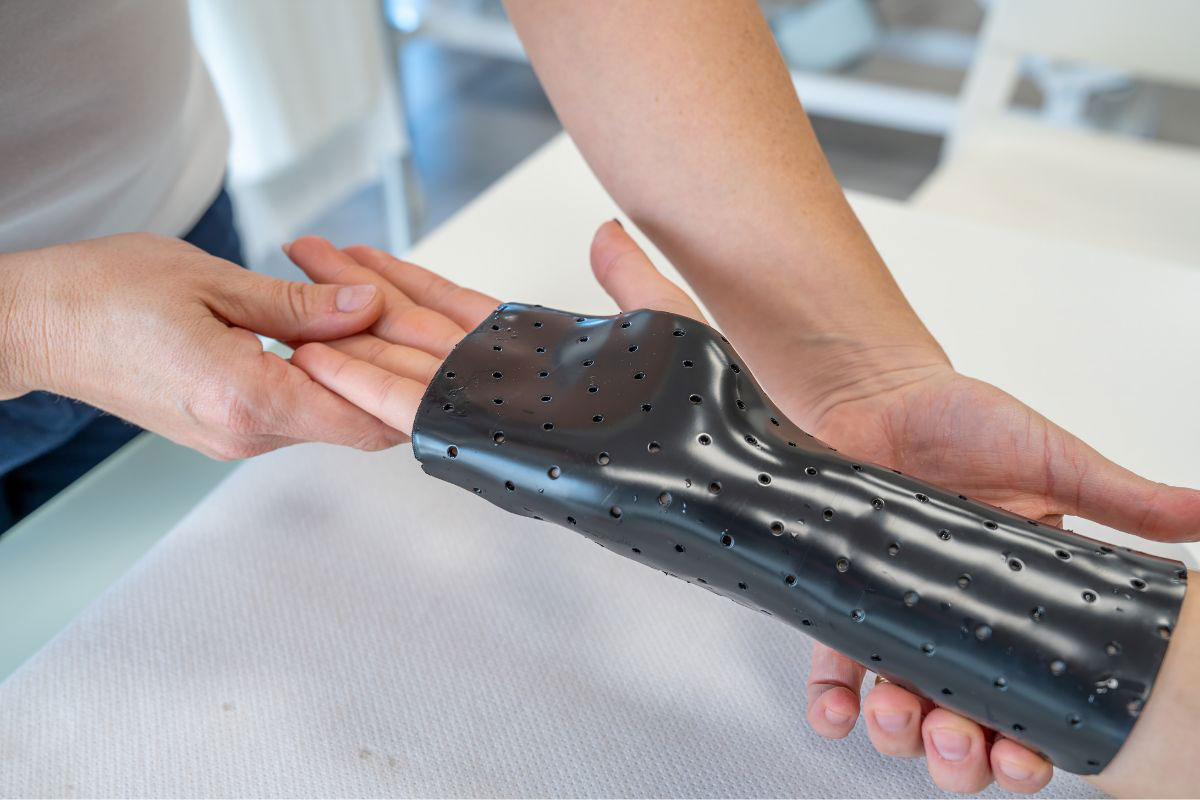
Medicare distinguishes between prefabricated (off-the-shelf) orthoses and custom-fabricated orthoses (made specifically from a mold or 3D scan of the patient's body).
Medicare assumes a prefabricated device will work unless your medical record explicitly proves otherwise. To receive approval for a custom-fabricated brace (such as a custom AFO or KAFO), your clinical records must document at least one of the following criteria:
Severe anatomical deformities or structural abnormalities that prevent a safe fit in a standard off-the-shelf brace.
Neurological, circulatory, or tissue-fragility conditions that present a high risk of skin breakdown.
The medical need to control movement across multiple physical planes (e.g., simultaneously controlling side-to-side ankle rolling and forward knee buckling).
Understanding CMS Prior Authorization
To protect against improper billing, the Centers for Medicare & Medicaid Services (CMS) mandates Prior Authorization for specific high-cost orthotic codes (including certain custom AFOs, KAFOs, knee braces, and spinal supports).
This means that after your orthotist evaluation, all documentation must be submitted to Medicare for review before the brace can be delivered. Knowing this helps prevent frustration during the mandatory administrative waiting period.
Replacement Rules: The 5-Year "Useful Lifetime" Policy
Patients frequently ask: How often will Medicare pay for a new brace?
Medicare applies a 5-Year Reasonable Useful Lifetime (RUL) standard to most durable medical equipment and orthotics*. Medicare generally will not replace a brace during this 5-year window simply due to normal wear and tear.
However, Medicare WILL cover a replacement within 5 years if one of two conditions is met:
A Significant Change in Patient Condition: If your physical health or anatomy changes significantly—such as major weight gain or loss, disease progression (e.g., stroke or ALS), surgical intervention, or physical growth in a child—your doctor can document why the existing device no longer meets your medical needs.
Accidental Damage or Loss: If the brace is lost, stolen, or damaged beyond repair in a specific, documented accident (e.g., a house fire or vehicle incident), Medicare will consider replacement.
*The 5-year RUL rule does not pertain to prosthetic devices. If you have questions about whether a new or replacement device will be covered, review your insurance policy or give us a call.

Checklist: Steps to Ensure a Smooth Medicare Process
For Patients & Families
[ ] Schedule a dedicated face-to-face appointment with your doctor within 6 months of needing your device.
[ ] Be specific with your doctor about your physical limitations (e.g., falls, balance issues, pain during walking).
[ ] Bring your primary Medicare card, secondary/supplemental insurance details, and prescription to your Floyd Brace evaluation.
[ ] Ask your orthotist if your brace requires CMS Prior Authorization so you can plan for delivery timelines.
For Referring Physicians & Care Teams
[ ] Document objective physical findings (range of motion, muscle strength, joint laxity, neurological status) in encounter notes.
[ ] Specify functional deficits and explain why lower-level or off-the-shelf alternatives are clinically insufficient.
[ ] Promptly review and sign co-managed documentation returned by the orthotist to prevent patient care delays.
Partner With Floyd Brace for Seamless Care
Navigating Medicare guidelines can feel complicated, but you don't have to manage it alone. At Floyd Brace, our experienced clinical and administrative teams work closely with you and your physicians to evaluate your needs, select the proper device, and streamline the insurance process from start to finish.
Expert care and heartfelt support since 1942.
Ready to take the next step toward improved mobility and independence? Contact us today to schedule an evaluation or find a location near you.
